It's 9 p.m., and your child is stuck on a Class 8 algebra problem. They open ChatGPT, paste in the question, and a full solution appears in a few seconds.
Homework done.
But did they actually learn anything?
This is the question many parents are facing now. AI is already part of the world children live in—from search engines and smartphones to educational tools and school discussions. Completely banning it isn't always practical. At the same time, letting children use AI to do all their homework can turn a learning tool into a shortcut.
The better approach is somewhere in the middle.
Use ChatGPT as a tutor, not as a homework replacement.
In this guide, we'll look at how students can use ChatGPT for homework without cheating, which prompts actually encourage learning, and how parents can set simple rules around AI use.
If you want to understand the bigger picture first, read our guide on how much AI children should use .
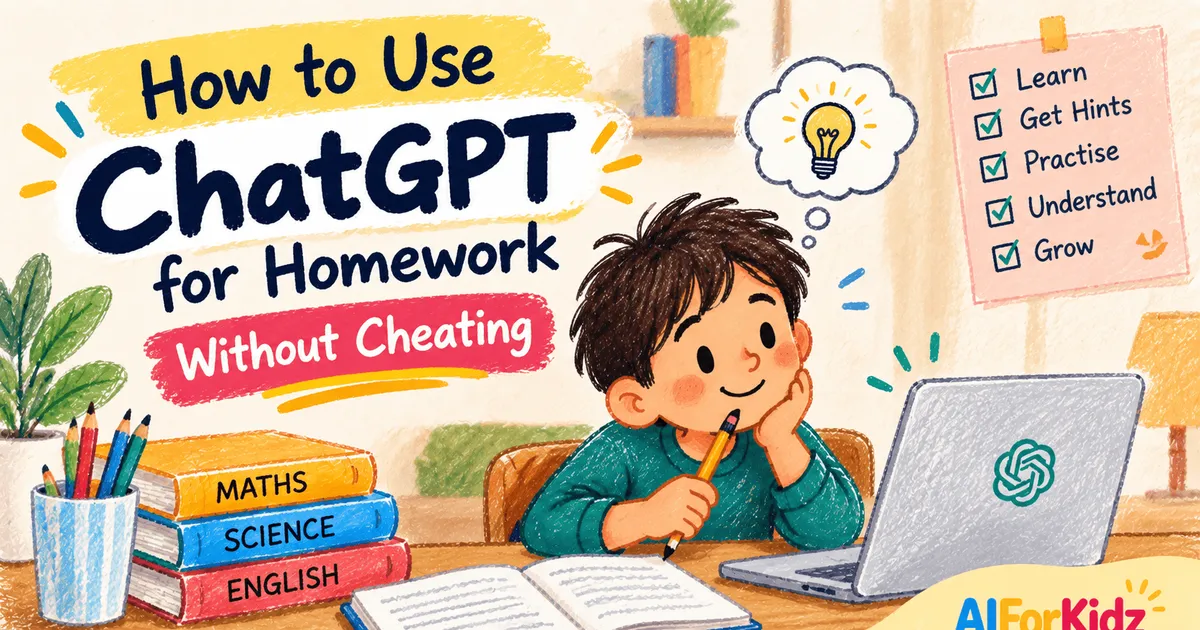
The AI Homework Rule: Try → Ask → Understand → Write → Check
Before we talk about prompts, here's one simple rule parents can teach their children:
1. TRY
Attempt the homework yourself first. Even if you don't know the complete answer, spend a few minutes thinking about it.
2. ASK
If you're stuck, ask ChatGPT for a hint, explanation or example.
3. UNDERSTAND
Don't stop at the answer. Make sure you understand why the answer is correct.
4. WRITE
Write the final answer yourself, in your own words.
5. CHECK
Use your textbook, notes or ChatGPT to check whether your answer makes sense.
Is Using ChatGPT for Homework Cheating?
It depends on how the student uses it.
If a student asks ChatGPT to write an entire essay and submits it as their own work, that's not really learning. It's essentially handing the assignment over to someone—or something—else.
But imagine a student is confused about photosynthesis and asks:
"Can you explain photosynthesis in simpler words?"
They read the explanation, understand the concept and then write their own answer.
That's a very different use of AI.
A simple test parents can use is:
Can your child explain the answer without looking at ChatGPT?
If they can explain the idea, show the steps and answer follow-up questions, they probably learned something.
If they only know how to copy and paste the answer, the AI did the learning for them.
How Can Students Use ChatGPT for Homework?
ChatGPT can be useful when students use it to learn, practise and check.
Good uses
- Asking for a difficult concept to be explained in simpler language
- Getting another explanation when the textbook isn't clear
- Asking for practice questions
- Getting hints instead of complete solutions
- Checking their own written answer
- Finding common mistakes in a topic
- Creating a quiz from a chapter
- Brainstorming ideas for a school project
- Asking for real-life examples of something they learned
Uses to avoid
- Copying a complete answer and submitting it
- Asking AI to write an entire essay for submission
- Getting maths problems solved without understanding the steps
- Copying AI-generated paragraphs word for word
- Using AI before even attempting the question
- Assuming every AI answer is automatically correct
That last point is especially important.
ChatGPT can sound confident and still be wrong.
So children should learn to compare important information with their textbook, teacher's notes or another reliable source.
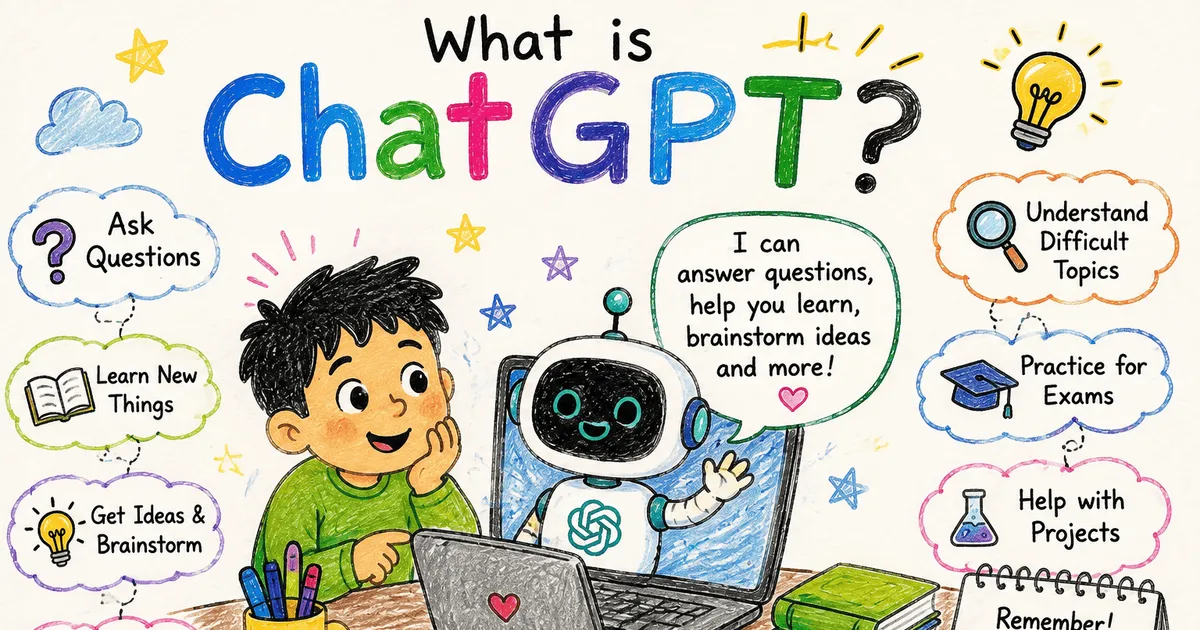
If your child is new to ChatGPT, our guide on what ChatGPT is and how it works explains the basics in simple language.
Bad Prompt vs Good Prompt
Sometimes the biggest difference isn't the AI tool. It's the question the student asks.
| Instead of asking... | Try asking... |
|---|---|
| "Solve this question." | "Give me a hint for the first step." |
| "Write my essay on pollution." | "Help me create an outline for an essay on pollution." |
| "Give me the answer." | "Explain how I can find the answer." |
| "Do my homework." | "Quiz me on this chapter." |
| "Write a paragraph about Newton's laws." | "Explain Newton's laws and give me points I can use to write my own paragraph." |
The goal isn't to stop children from using AI.
It's to change how they use it.
7 Safe ChatGPT Prompts for Homework Help
Here are seven prompts that encourage ChatGPT to teach rather than simply provide answers.
Notice the pattern.
These prompts ask AI to explain, question, guide and review.
They don't ask it to do the assignment.
How to Use ChatGPT for Maths Homework
Maths is one area where students can easily become dependent on AI.
For example, suppose the question is:
Solve: 3x + 7 = 22
A student could simply ask:
"Solve 3x + 7 = 22."
ChatGPT may immediately give the complete solution.
A better prompt would be:
"Help me solve 3x + 7 = 22 step by step. Don't give me the final answer immediately. Ask me what I should do at each step."
Now the student has to think.
The same approach works for fractions, algebra, geometry, percentages and word problems.
A useful rule for maths:
Ask for a hint before asking for a solution.
If the child is still stuck, ask for the next step.
The goal is to make AI a maths tutor, not a calculator that completes the worksheet.
How to Use ChatGPT for Science Homework
Science students can use AI to understand concepts that are difficult to visualise.
For example, instead of:
"Write an answer about the water cycle."
Try:
"Explain the water cycle in simple language and give me 4 points I can use to write my own answer."
Or:
"Explain evaporation and condensation using an example from everyday life."
The student still does the actual writing.
AI simply helps them understand the topic first.
How to Use ChatGPT for Project Work
School projects are another area where AI can become either helpful or harmful.
Instead of:
"Make my science project."
Try:
"Give me five simple science project ideas for Class 7 using materials I can find at home. Explain what each project demonstrates."
Then the student can choose one, research it, build it and explain it themselves.
AI provides ideas and guidance.
The student provides the thinking and work.
Age-Wise Guidance for Using ChatGPT
Different ages need different levels of guidance.
Under 13
OpenAI says ChatGPT is not intended for children under 13. For children aged 13–18, parental consent is required. OpenAI also says that when ChatGPT is used educationally with children under 13, the actual interaction should be conducted by an adult.
For younger children, parents should not simply hand over an AI tool and leave them alone.
If you're exploring AI with a younger child, sitting together and treating it as a shared learning activity is a better approach.
Ages 13–15
This is a good stage to introduce clear rules.
- Try the question first
- Ask AI for explanations or hints
- Don't copy complete answers
- Check important facts
- Be able to explain submitted work
- Follow the school's AI rules
Ages 16 and above
Older students can gradually have more independence.
But independence shouldn't mean "AI does everything."
Students preparing for board exams, entrance tests or college should especially practise solving problems and writing independently because those skills still matter when AI isn't available.
Can Teachers Tell If Homework Was Written by ChatGPT?
AI detection isn't as simple as uploading an assignment and getting a reliable "AI" or "human" answer.
AI detectors can make mistakes, so they shouldn't be treated as a perfect way to determine authorship.
Teachers may instead notice things such as:
- A sudden change in writing style
- Vocabulary the student normally doesn't use
- An unusually polished answer
- Answers that don't match the student's understanding
- A student being unable to explain what they submitted
But there's a bigger issue than getting caught.
What happens when the exam arrives?
If ChatGPT completed the homework, but the student never learned the concept, the shortcut has simply moved the problem to a later date.
The real goal isn't to make homework "AI-free."
It's to make sure the student is still doing the thinking.
Is ChatGPT Allowed in Indian Schools?
There isn't one universal rule for every school or every assignment.
A school may allow AI for brainstorming or research while asking students not to use it to write final submissions. Another teacher may have different rules for a particular assignment.
So students should follow the instructions given by their school or teacher.
At the same time, AI education itself is becoming part of school education in India.
For the 2026–27 academic session, CBSE has introduced a Computational Thinking and Artificial Intelligence curriculum for Classes III–VIII.
The curriculum focuses on computational thinking, AI readiness, digital literacy, responsible technology use and ethical decision-making.
CBSE has also released student and teacher resources for the Classes III–VIII CT & AI curriculum.
That means children aren't simply learning how to use technology.
They're increasingly learning how to think about technology.
But this doesn't mean ChatGPT is automatically allowed for every piece of homework.
Always check your school's rules for the specific assignment.
How Parents Can Set Simple AI Homework Rules
You don't need to understand AI technically to guide your child.
1. Make one rule clear
AI can explain and check. It shouldn't replace your child's work.
2. Ask, don't accuse
Instead of:
"Did ChatGPT do your homework?"
Try:
"Show me how you used AI for this."
That creates a conversation rather than a confrontation.
3. Ask your child to teach you
Say:
"Okay, now explain this answer to me."
If they understand it, they'll usually be able to explain it.
4. Compare answers with the textbook
Occasionally take an AI answer and compare it with the child's textbook. If there's a difference, discuss why.
This teaches an important lesson: AI isn't always right.
5. Set boundaries around independent work
Some homework should simply be done without AI.
Reading, mental maths, handwritten practice and exam-style questions are still valuable.
6. Check available safety controls
For teen accounts, OpenAI currently offers parental-control features in supported experiences. Availability and settings can change, so parents should check the current options available to their account.
Warning Signs of AI Over-Reliance
Using AI doesn't automatically mean a child is becoming dependent on it.
But watch for patterns such as:
- Homework gets completed unusually quickly while test performance falls
- Your child can't explain their own answers
- They open ChatGPT before attempting a question
- Their writing suddenly sounds very different
- They become uncomfortable doing assignments without AI
- They ask AI to complete even simple tasks they already know how to do
If you notice a few of these, don't panic.
Have a conversation.
The solution usually isn't to suddenly ban every AI tool. Instead, reset the rules.
Parent's AI Homework Checklist
Before your child submits AI-assisted homework, ask:
- Did I try the question myself first?
- Did I use AI to understand rather than simply copy?
- Did I write the final answer myself?
- Did I check important information?
- Can I explain my answer without looking at ChatGPT?
If the answer is yes to all five, AI is much more likely to be supporting learning rather than replacing it.
Frequently Asked Questions
Is using ChatGPT for homework cheating?
Not necessarily. It depends on how it is used and what the school or teacher allows. Using ChatGPT to understand a concept or check your own work is different from submitting an AI-generated answer as your own.
Is it okay to use ChatGPT to check my homework?
Yes. One useful approach is to complete the work yourself first and then ask ChatGPT to identify possible mistakes or areas that need improvement.
What age can children use ChatGPT?
OpenAI says ChatGPT is not intended for children under 13. Users aged 13–18 need parental consent. Educational use involving children under 13 should have an adult conduct the actual interaction.
Will using AI make my child lazy?
Not automatically. The effect depends largely on how the tool is used. Asking for explanations, practice questions and feedback can support learning, while asking AI to complete every assignment can reduce opportunities for independent thinking.
Should parents ban ChatGPT completely?
There is no single answer for every family. Younger children need more supervision, while older students can gradually learn responsible and independent use. School rules should also be considered.
Can ChatGPT give wrong answers?
Yes. AI systems can produce incorrect or misleading information while sounding confident. Students should learn to verify important information, especially for schoolwork.
Is ChatGPT safe for kids?
It isn't automatically appropriate for every child or situation. OpenAI says ChatGPT isn't intended for children under 13 and recommends caution even for children who meet its age requirements.
The Bottom Line
ChatGPT isn't a replacement for a teacher, a textbook or your child's own thinking.
It's a tool.
And like any tool, how it is used matters more than simply whether it is used.
A child who asks:
"Give me the answer."
is using AI very differently from a child who asks:
"Help me understand how to find the answer."
That's the habit parents should try to build.
Don't teach children to avoid AI.
Teach them to use it without giving up their own thinking.
Because the goal of homework was never just to finish the worksheet.
The goal was to learn.