How Much AI Should Children Use? A Parent’s Guide to Healthy AI Use
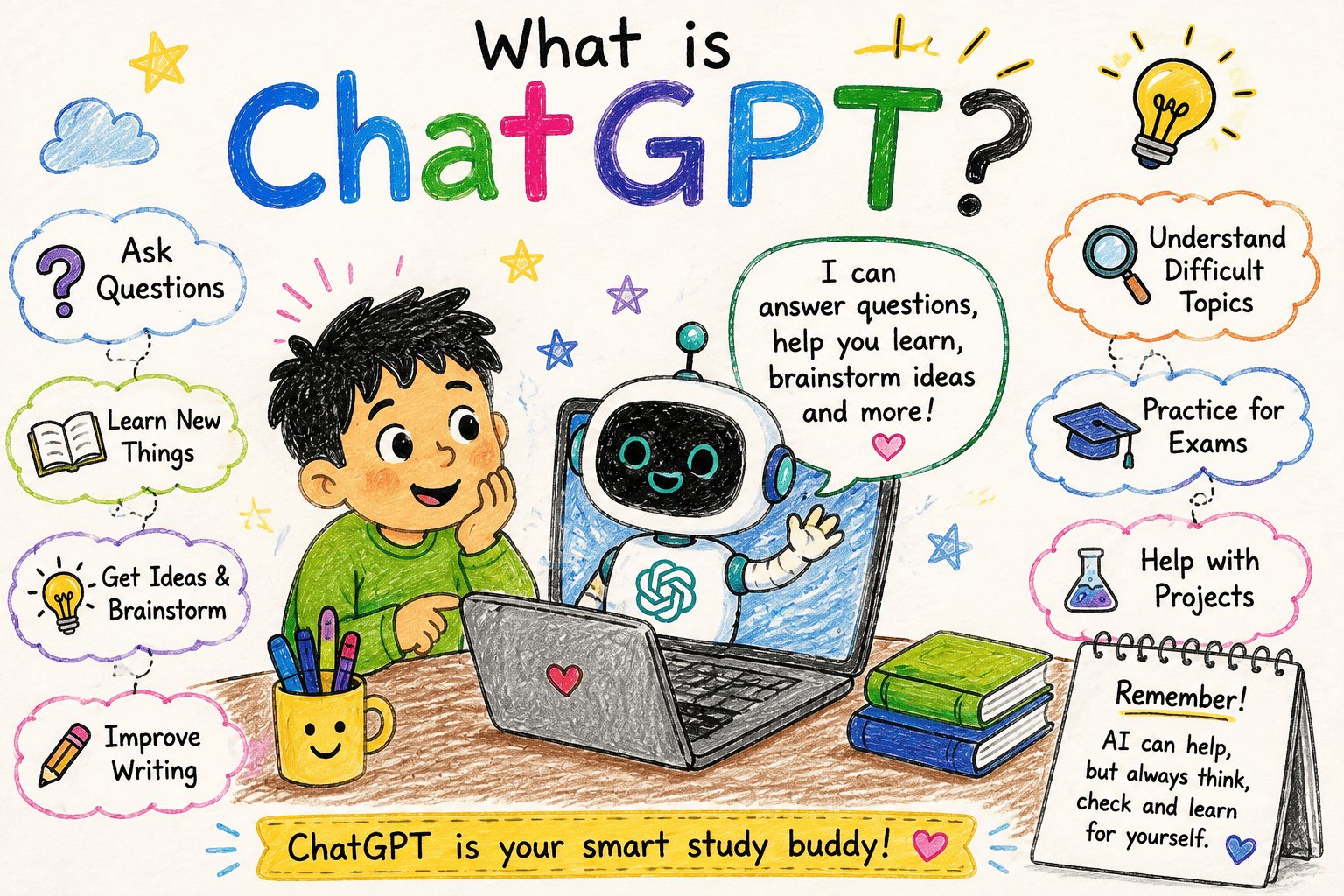
Artificial intelligence is becoming a normal part of everyday life. Children are using AI to ask questions, understand difficult topics, brainstorm ideas, write stories, learn languages, and even explore coding.
But as AI becomes easier for children to access, many parents are asking: How much AI should children use?
The answer is not as simple as setting a timer. A child spending 20 minutes using AI to understand a difficult maths concept is very different from spending 20 minutes asking AI to complete an entire homework assignment.
What matters is not only how long children use AI, but also why they are using it, what they are doing with it, and whether AI is supporting or replacing their own thinking.
Is There a Recommended Amount of AI Time for Children?
There is currently no universal number of minutes or hours that can be considered the right amount of AI use for every child.
Children have different ages, learning needs, schedules, interests, and levels of digital maturity. AI can also be used for very different purposes.
For example:
- A child may use AI for 15 minutes to understand fractions.
- Another child may use AI to brainstorm ideas for a science project.
- A teenager may use an AI coding tool while learning Python.
- Another child may repeatedly ask AI to complete homework without trying independently.
These activities may take similar amounts of time, but their educational value can be very different.
This is why parents should think beyond “How many minutes?” and also ask, “What is my child doing with AI?”
The American Academy of Pediatrics also notes that there is not enough evidence for one universal screen-time limit that applies to every child. Instead, families are encouraged to consider the quality and context of digital activities, along with sleep, physical activity, relationships, and other parts of daily life.
AI Use Should Be About Purpose, Not Just Time
A useful way to think about children's AI use is to divide it into three broad categories: learning, creating, and consuming.
1. Learning With AI
AI can act as a learning assistant when children use it to understand concepts, explore questions, or receive explanations.
For example, a child could ask:
“Explain photosynthesis like I am 10 years old.”
The child can then ask follow-up questions, compare the explanation with a textbook, and discuss what they learned with a teacher or parent.
Used this way, AI can become a tool for curiosity and exploration rather than simply an answer generator.
2. Creating With AI
Children can also use AI as a creative partner. They might use it to:
- Brainstorm a story
- Develop a science-project idea
- Create questions for a quiz
- Practice a language
- Explore coding ideas
- Organize their thoughts
- Generate ideas for an art project
The important part is that the child remains involved in the creative process.
3. Consuming AI-Generated Answers
AI becomes less helpful when children treat it as a tool that simply produces answers for them.
For example, if a student copies an AI-generated essay without reading, checking, or understanding it, the task may be completed but the learning opportunity can be lost.
The goal should not be to prevent children from using AI. It should be to help them become active users rather than passive users.
How Much AI Should Children Use at Different Ages?
The way children use AI should change as they grow. Younger children generally need more guidance, while older students can gradually take greater responsibility for how they use AI.
Younger Children
For younger children, AI use should be more guided and purposeful.
Parents and teachers can introduce age-appropriate activities such as asking simple questions, creating stories, learning basic concepts, or exploring beginner coding ideas.
Younger children may also find it difficult to recognize when an AI answer is incorrect. Adult guidance can therefore help them understand that AI does not automatically provide correct information.
Middle-School Children
As children become more independent, they can begin exploring AI for research, learning, creativity, and problem-solving. At the same time, they should learn how to question and verify AI-generated information.
Encourage children to ask:
- Where did this information come from?
- Could this answer be wrong?
- Can I verify it using my textbook or another reliable source?
- Can I explain the answer in my own words?
These habits can help children develop stronger digital and information literacy.
Teenagers
Teenagers may use AI for more advanced activities such as research, coding, writing support, brainstorming, and academic projects.
At this stage, parents can focus increasingly on responsible habits rather than simply monitoring every interaction.
Teenagers should understand topics such as privacy, plagiarism, misinformation, AI-generated content, bias, and independent thinking.
UNICEF's guidance on AI and children emphasizes the importance of protecting children's safety and privacy while also preparing them with the skills they need to participate in an AI-enabled world.
When Does AI Use Become Too Much?
“Too much” AI use is not necessarily defined by a particular number of minutes. A more useful question is whether AI is beginning to interfere with important parts of a child's life.
Parents should pay attention if AI use starts replacing:
- Sleep
- Physical activity
- Family interaction
- Friendships
- Outdoor play
- Reading
- Creative activities
- Independent schoolwork
- Face-to-face communication
For example, if a child regularly turns to AI instead of attempting a problem independently, or if AI use begins interfering with sleep, school responsibilities, relationships, or offline activities, parents may need to reconsider how the technology is being used.
The American Academy of Pediatrics recommends thinking about balance, boundaries, and communication when families are managing children's technology use rather than relying only on a fixed number of screen minutes.
AI Should Not Replace a Child's Thinking
One of the most important principles for children using AI is simple: AI should support a child's thinking—not replace it.
Imagine that a student receives a difficult maths problem.
Approach 1: Ask for the Answer
The child asks: “Give me the answer.”
The child may get a correct answer, but they may not understand how the problem was solved.
Approach 2: Ask for a Hint
The child asks: “I tried solving this problem and got stuck at this step. Can you give me a hint without giving me the final answer?”
Now AI becomes a learning partner rather than a replacement for thinking.
This approach gives children an opportunity to think, make mistakes, ask questions, and improve.
The long-term goal of education is not simply getting correct answers. It is also developing problem-solving, reasoning, creativity, and independent thinking skills.
AI can influence several areas of a child's development, including learning, creativity, critical thinking, and independence. For a deeper look at this topic, read about the impact of AI on children's development .
5 Simple Rules for Healthy AI Use
1. Ask “Why Are You Using AI?”
Before focusing on the timer, understand the purpose. Is your child learning something, creating something, researching, or simply looking for an easy answer?
2. Encourage Children to Try First
For homework and problem-solving, encourage children to make their own attempt before asking AI for help.
AI can then be used to explain mistakes, provide hints, or suggest another way to approach the problem.
3. Teach Children to Verify AI Answers
AI systems can produce incorrect information. Children should understand that an AI-generated answer is not automatically a fact.
Encourage them to check important information using textbooks, teachers, trusted websites, or other reliable sources.
4. Protect Personal Information
Children should learn not to casually share sensitive personal information with AI tools.
- Passwords
- Home addresses
- School identification details
- Private photographs
- Financial information
- Personal conversations
- Other sensitive family information
UNICEF specifically highlights children's data protection and privacy as important considerations for child-centred AI.
5. Keep AI Balanced With Real Life
AI can have a useful place in a child's life, but it should not become the centre of it.
Children still need time for sleep, exercise, reading, hobbies, friends, family, outdoor activities, and learning without a screen.
A Better Question Than “How Much AI?”
Instead of asking only: “How much AI should my child use?”, parents can ask five simple questions:
- Why is my child using AI?
- Is the activity age-appropriate?
- Is my child learning or simply copying?
- Can my child explain what the AI produced?
- Is AI interfering with sleep, school, relationships, or offline activities?
These questions can provide more useful context than a simple timer.
Frequently Asked Questions
How much AI should a 10-year-old use?
There is no universally established daily AI time limit specifically for 10-year-olds. Parents should consider the child's age, maturity, purpose of use, type of AI activity, and whether AI use is affecting sleep, schoolwork, physical activity, relationships, or independent learning.
Is AI safe for children?
AI can provide educational and creative opportunities, but it can also involve risks such as inaccurate information, privacy concerns, inappropriate content, bias, and overdependence. Age-appropriate tools, clear boundaries, and adult guidance can help children use AI more responsibly.
UNICEF's guidance highlights child safety, privacy, fairness, transparency, development, and age-appropriate preparation as important principles for AI involving children.
Should children use AI for homework?
AI can be useful for explaining concepts, generating practice questions, giving hints, or helping students understand mistakes. However, children should not rely on AI to complete work they are expected to understand themselves.
Can AI affect children's learning?
AI can influence how children learn, depending on how it is used. Used thoughtfully, it can support exploration, explanations, creativity, and accessibility. Used as a shortcut for every task, it may reduce opportunities for children to practise independent thinking and problem-solving.
Research into the longer-term effects of AI on children's cognitive, social, and emotional development is still developing, so parents should avoid treating early findings as final conclusions.
What should parents do if their child uses AI every day?
Daily AI use is not automatically a problem. Parents should look at what the child is doing with AI and whether that use is balanced with offline activities and responsibilities.
Setting family expectations around privacy, homework, bedtime, verification, and independent work can help children develop healthier AI habits.
Final Thoughts
There is no magic number that tells every family exactly how many minutes a child should spend using AI.
The better goal is healthy and purposeful AI use.
Children can use AI to ask questions, explore ideas, create, practise, and solve problems. But they should also have opportunities to think, make mistakes, research independently, and learn without AI.
As artificial intelligence becomes a bigger part of education and everyday life, teaching children how to use AI responsibly may be more valuable than simply teaching them how to use an AI tool.
The goal isn't to keep children away from AI.
The goal is to help them grow into thoughtful, capable, and responsible users of it.