
Have you ever started an AI project with an exciting idea but struggled to decide what problem it should solve? The issue may not be your idea. It may be that the problem has not been clearly defined.
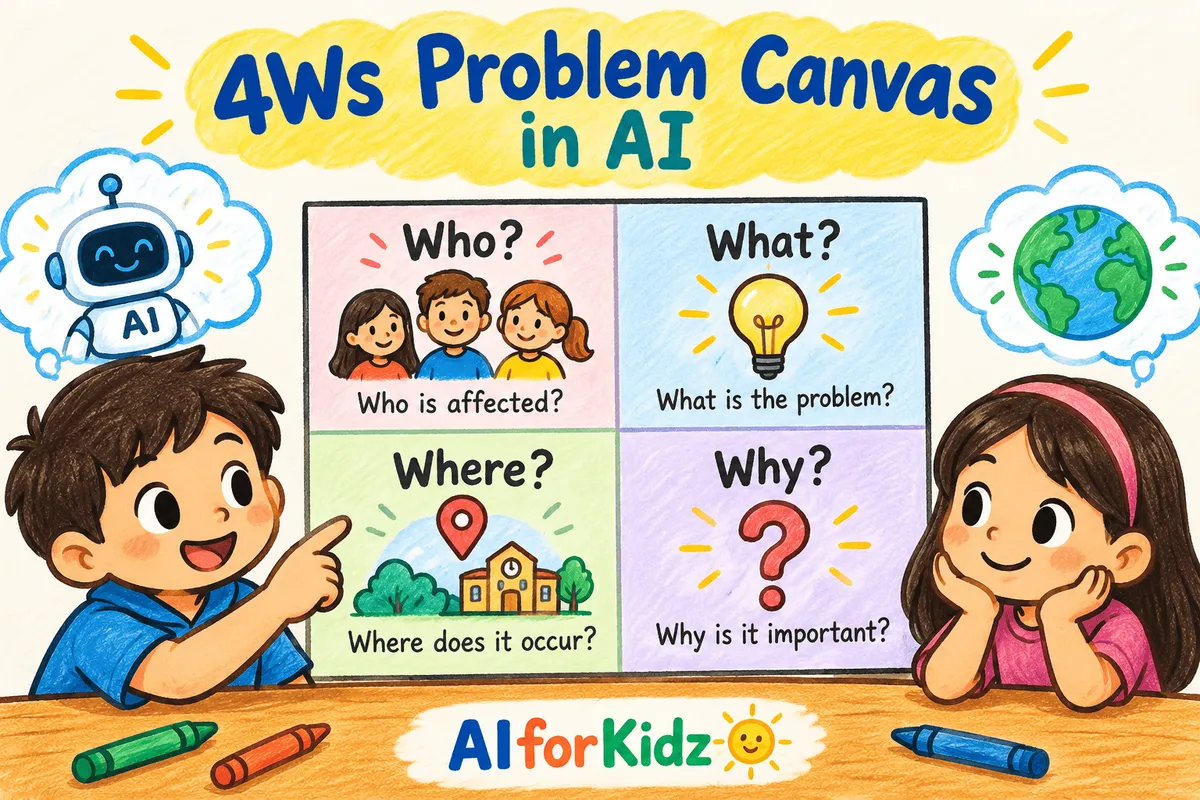
The 4Ws Problem Canvas helps students understand a problem before planning a solution. It asks four important questions: Who is affected, What is the problem, Where does it occur, and Why should it be solved?
In this guide, you will learn what the 4Ws Problem Canvas means, how it fits into the AI Project Cycle, and how to use it through a practical school example.
What Is the 4Ws Problem Canvas?
The 4Ws Problem Canvas is a problem-scoping tool used to understand and define a problem before developing a solution. It helps students identify the people affected, describe the problem using evidence, understand its context, and explain why solving it would be beneficial.
The four questions are:
- Who: Who experiences or is affected by the problem?
- What: What is the problem, and what evidence shows that it exists?
- Where: Where or in what situation does the problem occur?
- Why: Why is solving the problem important?
Answering these questions helps students understand a problem from different perspectives instead of immediately choosing a technology or building an application.
Watch: Understanding the 4Ws Problem Canvas
Watch the video below for an introduction to the 4Ws Problem Canvas. Then continue reading to see how the framework can be applied to a school-based problem.
The video introduces the topic, while the sections below explain the four Ws with an example and a student practice activity.
Where Does the 4Ws Problem Canvas Fit in the AI Project Cycle?
The AI Project Cycle provides a structured approach to understanding a problem, working with data, and developing an AI-based solution. In the commonly taught five-stage cycle, the stages are problem scoping, data acquisition, data exploration, modelling, and evaluation.
- Problem Scoping: Understand the problem, the people affected, and the intended outcome.
- Data Acquisition: Collect relevant information or data.
- Data Exploration: Examine the data to understand patterns, gaps, and relationships.
- Modelling: Develop a suitable model using appropriate methods and data.
- Evaluation: Assess how well the model performs against the project goal.
The 4Ws Problem Canvas is used during problem scoping. If the problem is poorly defined, students may collect irrelevant data or develop a solution that does not address the actual need.
For official curriculum information, explore the CBSE Computational Thinking and Artificial Intelligence resources and the official CBSE Academic website for resources relevant to your class and academic session.
Understanding the Four Ws of the Problem Canvas
1. Who: Who Is Affected by the Problem?
The Who section identifies the stakeholders. Stakeholders are people who experience a problem, are affected by it, or could benefit from a solution.
For a school canteen food-waste project, stakeholders could include students who buy lunch, canteen staff who prepare meals, and school management responsible for resources.
Be specific. Instead of writing only "people" or "students", identify the group relevant to the problem and consider what you know about their needs.
2. What: What Exactly Is the Problem?
The What section describes the problem and identifies evidence that supports its existence. Evidence might come from observations, surveys, interviews, reliable reports, or relevant records.
For example, students might observe uneaten food after lunch and record the amount left over for several school days. These observations can help them investigate whether food waste is a recurring issue.
Avoid presenting assumptions as facts. If you have not collected measurements, explain that the problem needs further investigation.
3. Where: Where Does the Problem Occur?
The Where section identifies the location, situation, or context in which the problem occurs. Defining the context keeps the project focused and makes it easier to collect relevant information.
Food waste might occur in a school canteen after lunch, at a school event, or at home when more food is prepared than needed. Each situation may require a different approach.
4. Why: Why Is Solving the Problem Important?
The Why section explains the expected benefits of addressing the problem. Consider how a solution could help stakeholders and what positive change it might create.
Reducing food waste could lower unnecessary food costs, help staff plan meal quantities, and reduce the amount of food sent for disposal.
For broader environmental or social projects, students can explore the United Nations Sustainable Development Goals to understand how their project relates to wider objectives.
4Ws Problem Canvas Example: Food Waste in a School Canteen
Imagine a group of students wants to investigate food waste in their school canteen. They use the 4Ws Problem Canvas to organise what they know and what they still need to investigate.
Note: This is an illustrative scenario, not a report of measured findings. Students should collect their own observations before making claims about the scale of the problem.
| The W | Example Answer |
|---|---|
| Who | Students buying lunch, canteen staff, and school management. |
| What | Uneaten food may be discarded after lunch. Students can investigate this by recording leftovers over several days. |
| Where | The school canteen, particularly after the lunch break. |
| Why | Reducing avoidable waste could save money and resources and improve meal planning. |
Once the four sections are complete, students can summarise the problem and decide what evidence they need before proposing a solution.
How to Write a Problem Statement Using the 4Ws
A problem statement is a short description of the issue, the people affected, the context, and the intended benefit. It turns the information in the canvas into a clear project goal.
A useful template is:
Our [stakeholders] have a problem of [the issue] when or where [the context]. An ideal solution would [the expected benefit].
Example Problem Statement
Our canteen staff and students face the problem of food waste in the school canteen after lunch. An ideal solution would help staff estimate daily food requirements more accurately, reducing unnecessary food preparation and waste.
This statement identifies the stakeholders, issue, context, and desired benefit. It does not assume that AI is necessarily the right answer.
Students should investigate the problem and consider alternatives before choosing a solution. If relevant historical data is available, they could explore whether an AI model might help estimate demand. Simpler meal-planning methods may also be sufficient.
Blank 4Ws Problem Canvas Template for Students
Use this template to investigate a problem at school, at home, or in your neighbourhood. Write short, specific answers in each section.
| Section | What to Write | Your Notes |
|---|---|---|
| Who | Who is affected by the problem? | ________________________ |
| What | What is the problem? What evidence supports it? | ________________________ |
| Where | Where or in what situation does it occur? | ________________________ |
| Why | Why is solving the problem important? | ________________________ |
Your Practice Challenge
Choose one issue you can observe, such as unnecessary electricity use in empty classrooms, long canteen queues, or food waste.
- Observe the situation and identify the people affected.
- Collect evidence without making unsupported assumptions.
- Complete all four sections of the canvas.
- Write a problem statement using your findings.
- Consider two possible solutions and decide whether AI is needed.
Respect people's privacy and ask permission before collecting personal information or taking photographs.
Common Mistakes Students Should Avoid
1. Choosing a Problem That Is Too Broad
"Solve pollution" is too broad for most school projects. A more manageable starting point is investigating air quality around a particular school location.
2. Making Claims Without Evidence
Do not claim that food waste is increasing unless you have evidence showing that trend. Observations and records help establish what is actually happening.
3. Identifying Only One Stakeholder
Consider whether other people experience the problem or would benefit from a solution. Include stakeholders who are relevant to your project.
4. Starting With an AI Solution
Choosing to build a chatbot or prediction model before defining the problem can lead to unnecessary work. Understand the problem first and then evaluate possible solutions.
5. Writing a Vague Problem Statement
A statement such as "make school better" does not define a clear goal. Explain the issue, who is affected, the context, and the intended improvement.
Tips for a Strong 4Ws Problem Canvas
- Choose a problem you can observe in your surroundings.
- Talk to stakeholders to understand their experiences.
- Use evidence to support your understanding of the problem.
- Keep each section focused and specific.
- Explain the benefit of solving the problem.
- Consider simpler alternatives before deciding to use AI.
Frequently Asked Questions About the 4Ws Problem Canvas
What is the 4Ws Problem Canvas in AI?
It is a problem-scoping tool that helps students understand a problem through four questions: Who, What, Where, and Why.
What are the four Ws in the AI Project Cycle?
The four Ws are Who, What, Where, and Why. They help identify stakeholders, describe the problem and its evidence, define its context, and explain the benefits of solving it.
Which stage of the AI Project Cycle uses the 4Ws Problem Canvas?
The canvas is used during problem scoping, the stage focused on understanding and defining the problem before collecting data.
What is a problem statement in AI?
A problem statement briefly describes the issue, the people affected, the context, and the intended benefit of a solution.
Can the 4Ws Problem Canvas be used outside AI projects?
Yes. It can help students define problems for science exhibitions, environmental activities, school assignments, and other projects.
Does every problem need an AI solution?
No. Better planning, clear rules, or conventional software may be sufficient. AI should be considered when it is suitable for the problem and the available data.
Final Thoughts
The 4Ws Problem Canvas helps students move from a general idea to a clearly defined problem. By identifying stakeholders, gathering evidence, understanding the context, and explaining the expected benefit, students can plan more meaningful projects.
Try the blank canvas with a problem from your school or neighbourhood. Once you have a clear problem statement, you can begin investigating the information needed for the next stage: data acquisition.
Explore more student-friendly AI and technology learning resources in the AIForKidz.in blog.