Have you ever asked a question and wished you could get an answer instantly? Maybe you wanted to understand a difficult science topic, come up with an idea for a school project, or simply ask, “Why is the sky blue?”
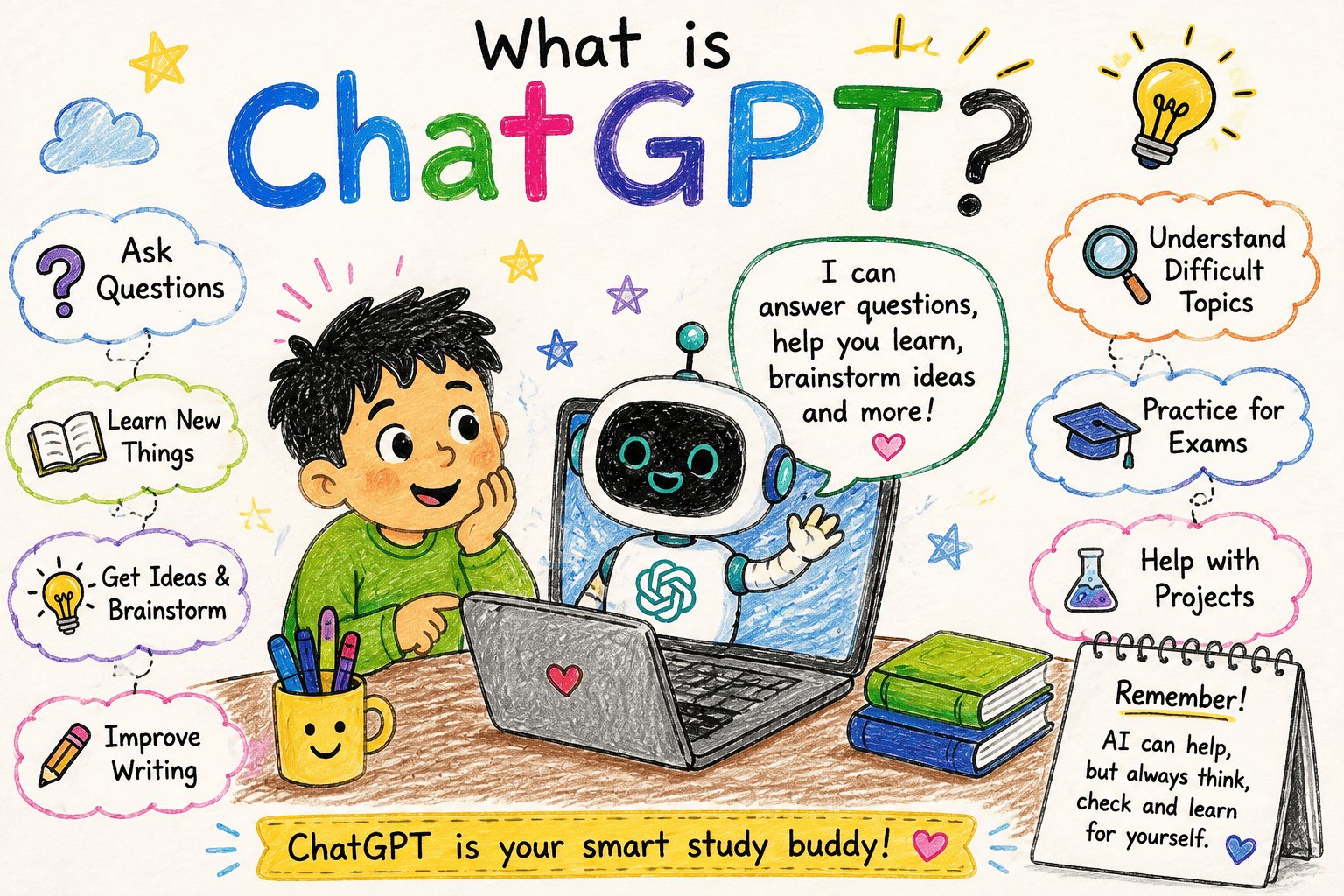
Today, tools like ChatGPT can help you explore questions, learn new things, brainstorm ideas, and even practice your writing.
But what exactly is ChatGPT? How does it know what to say? And should kids use it for schoolwork?
Let’s find out.
What Is ChatGPT?
ChatGPT is an artificial intelligence (AI) tool that can understand the questions and instructions people type and respond with text.
Think of it as a computer program you can have a conversation with.
You can ask ChatGPT things like:
- “Explain photosynthesis in simple words.”
- “Give me ideas for a science project.”
- “Help me practice English.”
- “Create a quiz about the solar system.”
- “Explain fractions with an example.”
Unlike a traditional search engine, which usually gives you a list of webpages, ChatGPT generates a response based on your conversation.
But there is something important to remember: ChatGPT is not a human and it does not always give the correct answer. That means kids should use it as a learning helper, not as a machine that is always right.
How Does ChatGPT Work?
This is where things get interesting.
ChatGPT is powered by a type of AI called a large language model, or LLM.
During its development, the model is trained using large amounts of text so that it can learn patterns in language. It learns how words and ideas are commonly connected and uses those patterns to generate responses.
For example, imagine you type:
“The Sun is a…”
You would probably expect the next word to be “star.”
ChatGPT works with language in a much more advanced way. It looks at the words and context in your conversation and generates a response one piece at a time.
This doesn't mean ChatGPT thinks exactly like a human.
It doesn't have human experiences, feelings, or personal memories in the way people do. Its responses are generated by the AI model based on patterns it has learned.
A Simple Way to Imagine It
Think about someone who has read thousands of books and studied many examples of how people communicate.
If you ask that person a question, they can use what they have learned to create an answer.
ChatGPT does something similar with language—but using an AI system rather than a human brain.
What Can Kids Do With ChatGPT?
There are many useful ways kids can use ChatGPT when it is used responsibly.
1. Understand Difficult Topics
Sometimes a textbook explanation can feel complicated.
You can ask ChatGPT to explain a topic in simpler language.
For example: “Explain gravity like I'm 10 years old.”
You can even ask for an example or analogy if the first explanation doesn't make sense.
2. Practice for Exams
ChatGPT can help you create practice questions.
For example: “Create 10 questions about the water cycle for a Class 6 student.”
You can then try answering the questions yourself.
This turns ChatGPT from an answer machine into a practice partner.
3. Brainstorm School Project Ideas
Stuck on a project?
Instead of asking ChatGPT to complete the entire project, ask it for ideas.
For example: “Give me five simple working model ideas for a school science exhibition.”
You can choose one idea, research it further, and create your own project.
4. Improve Writing
Writing a paragraph, story, or speech can sometimes be difficult.
ChatGPT can help you brainstorm characters, organize your ideas, or suggest ways to make your writing clearer.
But your final work should still sound like you.
5. Learn Through Questions
One of the best things about AI is that you can keep asking questions.
Suppose you're learning about space and ask: “What is a black hole?”
You can then ask:
- “Can you explain it with an example?”
- “What happens if something gets too close to a black hole?”
Learning becomes a conversation.
Should Kids Use ChatGPT for Homework?
This is an important question.
Using ChatGPT to understand a difficult concept can be helpful. Using it to copy an entire homework answer and submit it as your own is a different story.
Imagine your teacher gives you a math problem.
You could ask ChatGPT: “Show me how to solve this type of problem step by step.”
That's very different from simply copying the final answer.
The first approach helps you learn. The second may help you finish your homework, but you haven't necessarily learned anything.
The goal should be: Use AI to learn, not to avoid learning.
If you're using ChatGPT for a school assignment, check your teacher's rules first. Different schools and teachers may have different policies about AI.
Can ChatGPT Make Mistakes?
Yes.
This is one of the most important things every young AI user should understand.
ChatGPT can sometimes produce information that sounds confident but is incorrect. These errors are often called AI hallucinations .
For example, it might give you an incorrect fact, calculation, date, source, or explanation.
That's why you shouldn't automatically believe everything an AI tool tells you.
For important schoolwork, compare information with reliable sources such as your textbook, teacher, official educational websites, or other trusted references.
Remember This Simple Rule
AI can help you find an answer, but you should still think and check.
How to Write Better Prompts
The instructions you give ChatGPT are called prompts.
A clear prompt usually gets a more useful response.
Weak prompt:
“Tell me about planets.”
Better prompt:
“Explain the eight planets in our solar system for a Class 6 student using simple language and one interesting fact about each planet.”
See the difference?
The second prompt tells ChatGPT:
- What you want
- Who the explanation is for
- How detailed it should be
- What kind of information to include
You don't need complicated words to write a good prompt. You just need to be clear.
Is ChatGPT Safe for Kids?
AI tools should be used thoughtfully.
Kids should avoid sharing private information such as passwords, home addresses, phone numbers, school account details, or other sensitive personal information.
It's also a good idea for younger children to use AI with guidance from a parent, teacher, or another trusted adult.
And remember that not everything you see online—or everything an AI says—is automatically true.
Being a smart technology user means knowing when to question information.
ChatGPT Is a Tool, Not a Replacement for Your Brain
It's easy to think that AI can do everything.
It can write, explain, summarize, brainstorm, translate, and help with many different tasks. But that doesn't mean we should stop thinking for ourselves.
In fact, the more powerful AI becomes, the more important skills like critical thinking, creativity, problem-solving, communication, and curiosity become.
Think of ChatGPT like a bicycle.
A bicycle can help you travel faster, but you still have to decide where you want to go.
AI can help you learn faster, but you still need to decide what to learn, ask good questions, check information, and think for yourself.
Final Thoughts
ChatGPT is one of the most interesting examples of how artificial intelligence is changing the way we interact with technology.
For kids, it can be a useful learning companion. It can explain confusing topics, create practice questions, help brainstorm ideas, and make learning more interactive.
But the smartest way to use ChatGPT isn't to ask it to do everything for you.
Instead, ask questions, explore ideas, challenge the answers, verify important information, and use what you learn to create something of your own.
Technology is changing quickly, and kids who understand how these tools work will be better prepared to use them wisely.
So the next time you open ChatGPT, don't just ask:
“What is the answer?”
Try asking:
“Can you help me understand why?”
That's where the real learning begins.