
Imagine asking an AI chatbot to help you with homework. It gives you an answer in seconds. You copy it into your notebook, submit your assignment, and move on. But what if the answer is incorrect? What if the AI gives different answers to different people? And what happens to the personal information you shared with it?
These questions introduce us to an important topic: AI Ethics.
Artificial Intelligence is becoming part of everyday life. Students use AI-powered learning applications, teachers explore AI tools for classroom activities, and businesses use AI to make decisions. However, using intelligent technology also brings responsibilities.
AI should not only be powerful and useful; it should also be fair, safe, transparent, and respectful of people's privacy. Understanding these ideas helps students become responsible digital citizens who know how to use technology thoughtfully.
In this guide, we will explore what AI ethics means, why it matters, its important principles, and real-life examples that make the concept easier to understand.
Watch: Understanding AI and Ethics
Before exploring the topic in detail, watch this video to build a basic understanding of Artificial Intelligence and its ethical responsibilities.
What Is AI Ethics?
AI Ethics refers to the principles and guidelines that help people develop and use Artificial Intelligence responsibly. It focuses on ensuring that AI systems treat people fairly, protect personal information, avoid causing harm, and remain accountable for their impact on society.
In simple words, AI ethics teaches us how to use Artificial Intelligence in a way that is helpful, fair, safe, and respectful of human values.
Consider a simple example.
Suppose an AI-powered school admission system helps a school review student applications. If the system unfairly rejects students because of their background, gender, or other irrelevant characteristics, it creates an ethical problem.
The problem is not simply whether the technology works. The bigger question is whether it makes fair decisions.
This is why AI ethics matters. It encourages developers, organisations, educators, and users to think beyond what AI can do and consider what it should do.
Why Is AI Ethics Important?
AI systems can influence important areas of our lives, including education, healthcare, communication, employment, and online information. If these systems are designed or used carelessly, they can create problems for individuals and communities.
Here are some reasons why AI ethics is important:
1. It Helps Prevent Unfair Decisions
AI systems learn patterns from data. If their training data contains unfair patterns or does not represent different groups of people properly, the system may produce biased results.
For example, an AI-based recruitment tool might favour candidates whose profiles resemble those of people hired in the past. This could disadvantage equally qualified applicants from different backgrounds.
Ethical AI encourages developers to identify and reduce such unfair patterns.
2. It Protects Personal Information
Many AI applications process information such as names, photographs, voice recordings, location details, and other personal data.
Sharing unnecessary personal information with an AI tool can create privacy risks. AI ethics encourages responsible data collection, secure storage, and proper use of personal information.
3. It Builds Trust in Technology
People should be able to understand when AI is being used and why it produces a particular result, especially when that result affects an important decision.
Clear explanations and appropriate human supervision make AI systems easier to evaluate and trust.
4. It Reduces the Spread of Misinformation
Generative AI can create realistic-looking images, videos, audio, and written content. However, not everything generated by AI is true.
Students should learn to verify information before sharing it, particularly when content involves news, public figures, or sensitive topics.
5. It Keeps Humans Responsible
AI can assist people in analysing information and making decisions, but it should not automatically replace human judgement in every situation.
Important decisions require appropriate human review, especially when they affect someone's education, safety, rights, or opportunities.
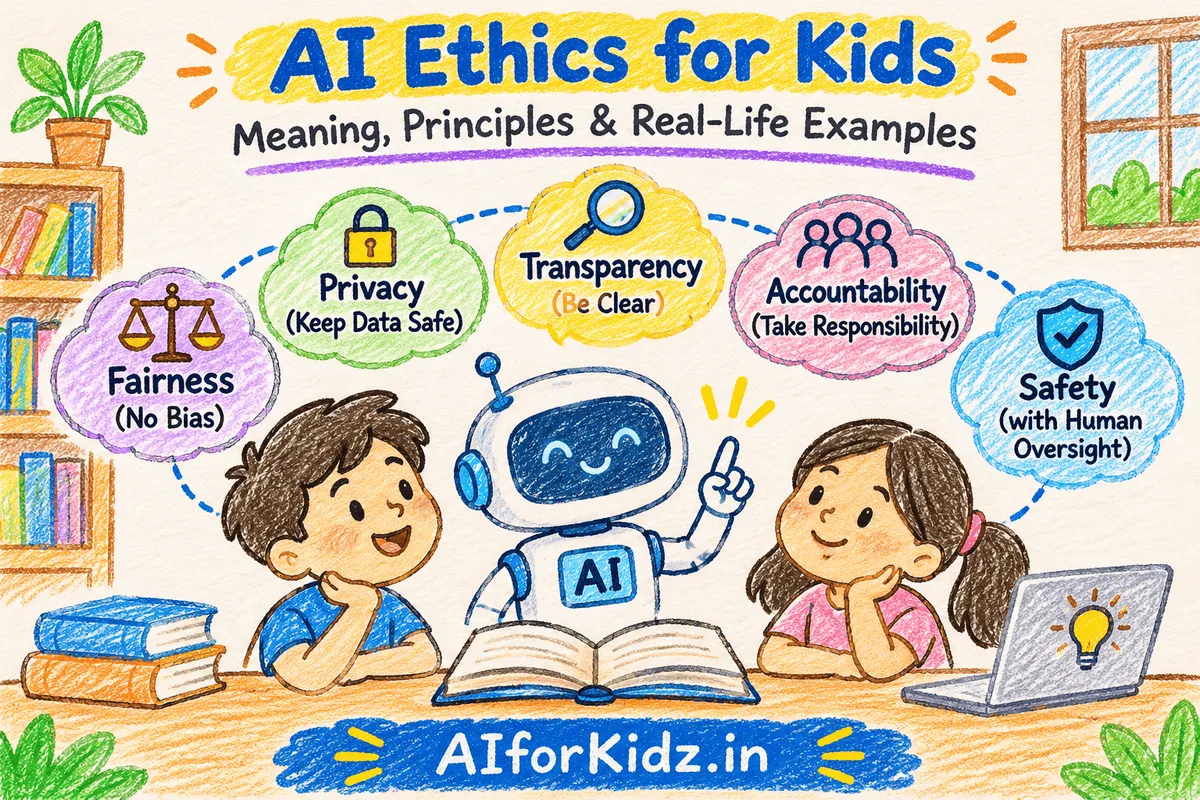
5 Important Principles of AI Ethics
Several principles help guide the responsible development and use of Artificial Intelligence. Let's understand five important ones through simple examples.
1. Fairness and Non-Discrimination
Fairness means AI systems should not treat people unfairly because of their gender, age, language, background, disability, or other personal characteristics.
Example: Imagine an AI-based scholarship selection system. It should evaluate applicants using relevant and appropriate criteria rather than favouring students from a particular background.
AI developers must examine training data and system behaviour to identify potential bias.
2. Privacy and Data Protection
Privacy means protecting personal information and ensuring that data is collected and used appropriately.
Example: A student uses an AI chatbot to understand a mathematics problem. The student should not share their home address, passwords, phone number, or private photographs just to receive an explanation.
Remember: Never share sensitive personal information with an AI application unless there is a clear and appropriate reason, and the tool has suitable privacy protections.
3. Transparency and Explainability
Transparency means being clear about how AI is being used. Explainability means providing understandable reasons for an AI system's output or decision where appropriate.
Example: If an AI system recommends a particular learning activity to a student, it should be possible to understand the factors behind that recommendation.
People should not have to blindly accept every AI-generated result.
4. Accountability and Responsibility
Accountability means that people and organisations responsible for developing, deploying, or using AI systems must take responsibility for their actions and the consequences of their systems.
Example: If an AI-powered application provides harmful or discriminatory recommendations, the organisation responsible for the system should investigate the problem and take appropriate corrective action.
AI cannot simply be blamed for every mistake. Human and organisational responsibilities still matter.
5. Safety and Human Oversight
AI systems should be designed and used in ways that reduce the risk of harm. Human oversight ensures that people can review important decisions, intervene when necessary, and correct mistakes.
Example: An AI tool may help doctors analyse medical images, but medical professionals must evaluate the results before making treatment decisions.
AI should support human expertise, not remove the need for responsible judgement.
Real-Life Examples of AI Ethics
AI ethics becomes easier to understand when we connect it with situations we encounter in everyday life.
Example 1: AI in School Admissions
A school uses AI to help review student applications. If the system consistently favours students from certain backgrounds because of patterns in historical data, it may create unfair opportunities.
Ethical concern: Bias and discrimination.
Responsible approach: Review the system's criteria, test it for unfair outcomes, and ensure meaningful human supervision.
Example 2: AI Chatbots and Student Privacy
A student asks an AI chatbot to help prepare a school project and uploads a document containing personal details.
Ethical concern: Privacy and data protection.
Responsible approach: Avoid uploading sensitive information and check the application's privacy settings and policies.
Example 3: AI-Generated Fake Images
Someone creates an AI-generated image showing a public figure doing something that never happened. The image is shared on social media without mentioning that it was generated using AI.
Ethical concern: Misinformation and lack of transparency.
Responsible approach: Verify the original source, check reliable news reports, and clearly label synthetic content when sharing it.
Example 4: AI in Online Recommendations
A video platform uses AI to recommend content based on a user's viewing activity. Over time, the recommendations may repeatedly show similar content and limit exposure to different perspectives.
Ethical concern: Transparency, user autonomy, and potential manipulation.
Responsible approach: Give users meaningful control over recommendations and encourage them to explore information from different reliable sources.
What Is AI Bias and Why Is It a Problem?
AI bias occurs when an AI system produces systematically unfair results for certain people or groups.
One important reason for AI bias is the data used to train a model.
Imagine training an image recognition system using thousands of photographs, but almost all the photographs show objects under similar lighting conditions. When the system encounters images with different lighting, its performance may decrease.
This example demonstrates how an incomplete or unrepresentative dataset can affect AI performance. In real-world situations involving people, similar problems can contribute to unfair outcomes.
Common Causes of AI Bias
- Biased training data: The data may contain historical discrimination or unfair patterns.
- Limited representation: Some groups or situations may be missing from the dataset.
- Human assumptions: Developers may unintentionally introduce their own assumptions when designing a system.
- Incorrect evaluation: A model may be tested on data that does not represent the people who will actually use it.
Reducing bias requires careful data collection, testing, evaluation, and continuous monitoring.
How Can Students Use AI Responsibly?
Understanding AI ethics is not only important for developers and researchers. Students also have a responsibility to use AI tools thoughtfully.
Here are seven practical habits students can follow:
- Verify AI-generated information: Check important facts using textbooks, official websites, and reliable sources.
- Protect personal information: Never share passwords, private photographs, addresses, or sensitive details unnecessarily.
- Use AI as a learning assistant: Ask AI to explain difficult concepts rather than copying complete assignments without understanding them.
- Acknowledge AI assistance: Follow your school's rules about disclosing AI-generated or AI-assisted work.
- Think before sharing: Do not forward AI-generated images, videos, or claims without checking their authenticity.
- Respect others: Never use AI to create misleading, harmful, discriminatory, or embarrassing content about another person.
- Keep human judgement: Make your own decisions instead of blindly following every AI recommendation.
AI Ethics and the CBSE Curriculum
AI ethics is also becoming an important part of school education in India. Students need more than the technical knowledge of how AI works. They should also understand how AI affects individuals, communities, and society.
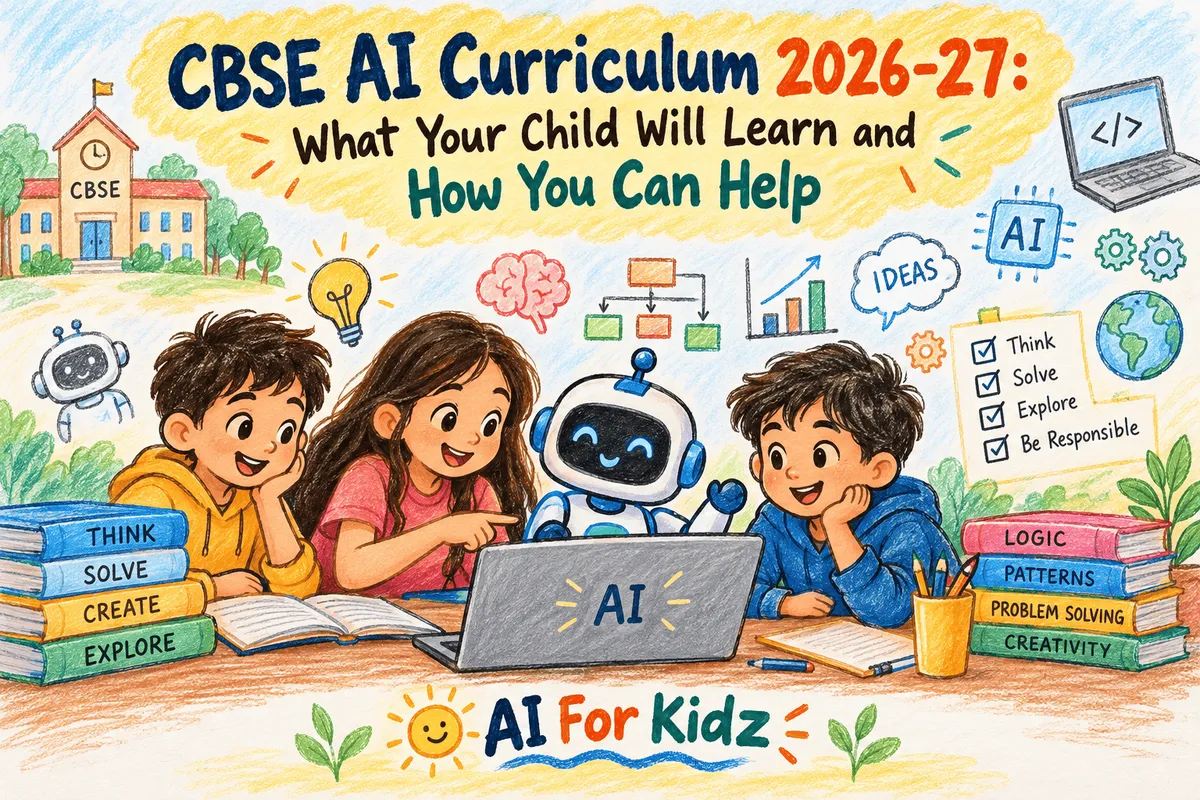
For the 2026–27 academic session, CBSE has introduced a Computational Thinking and Artificial Intelligence curriculum for Classes 3 to 8. The curriculum includes ethical considerations such as bias and fairness, along with understanding data-driven decisions.
This approach encourages students to develop computational thinking skills while learning about the responsible use of emerging technologies.
Students can explore the official resources here: CBSE Computational Thinking and AI Curriculum 2026–27.
Learning AI ethics at school helps students become thoughtful technology users rather than simply consumers of AI-powered applications.
Activity: Can You Identify the Ethical Problem?
Let's test your understanding with a few everyday situations.
Situation 1: A student uploads their home address and phone number to an AI chatbot while asking for homework help.
Question: Which ethical principle is being ignored?
Answer: Privacy and data protection.
Situation 2: An AI recruitment system rejects equally qualified candidates because of unfair patterns in its training data.
Question: What is the main ethical concern?
Answer: AI bias and discrimination.
Situation 3: A student shares an AI-generated fake news image without checking whether it is real.
Question: What should the student have done?
Answer: Verify the information and avoid spreading misinformation.
Frequently Asked Questions About AI Ethics
1. What is AI ethics in simple words?
AI ethics refers to the principles that guide people in developing and using Artificial Intelligence fairly, safely, and responsibly while respecting human rights and values.
2. What are the five main principles of AI ethics?
Five important principles are fairness, privacy, transparency, accountability, and safety with human oversight. Other frameworks also emphasise inclusion, sustainability, and human rights.
3. Why should students learn AI ethics?
Students should learn AI ethics to understand the risks and responsibilities associated with AI, protect their personal information, identify misinformation, and use digital tools responsibly.
4. What is an example of AI bias?
An example is an AI recruitment system that unfairly favours certain candidates because its training data contains historical patterns of discrimination.
5. Is using AI for homework ethical?
Using AI to understand concepts, explore ideas, and practise questions can be helpful. However, submitting AI-generated work as your own without understanding it or following your school's academic rules is not responsible use.
6. Can AI make ethical decisions?
AI can be designed to follow rules and guidelines, but it does not replace human moral judgement and responsibility. Important decisions require appropriate human oversight.
7. What is the difference between AI and ethical AI?
AI refers to technology that performs tasks associated with human intelligence, while ethical AI focuses on ensuring that these systems are designed and used responsibly, fairly, and safely.
Conclusion: AI Should Be Intelligent, But Also Responsible
Artificial Intelligence has enormous potential to improve education, healthcare, communication, and many other areas of life. But technological progress should not be measured only by how fast or powerful an AI system becomes.
We must also ask whether it respects privacy, treats people fairly, provides reliable information, and allows humans to remain responsible for important decisions.
For students, understanding AI ethics is the first step towards becoming responsible digital citizens. The goal is not to avoid AI, but to understand it, question it, and use it wisely.
Remember: The future of AI should not only be about building smarter machines. It should also be about making better decisions for humanity.
Explore More Learning Resources
Want to understand Artificial Intelligence beyond its basic concepts? Explore more educational resources, practical activities, and beginner-friendly AI guides on AIForKidz.
Keep learning, keep questioning, and use technology responsibly!
References and Further Reading
-
UNESCO – Recommendation on the Ethics of Artificial Intelligence
International guidance covering fairness, transparency, privacy, human oversight, and responsible AI.
-
UNICEF – Guidance on AI and Children
Guidance on protecting children's rights, safety, privacy, and well-being in AI systems.
-
NIST – AI Risk Management Framework
A framework for understanding and managing risks associated with AI systems.
-
CBSE – Computational Thinking and Artificial Intelligence Curriculum
Official CBSE curriculum resources for Classes 3 to 8 for the 2026–27 academic session.