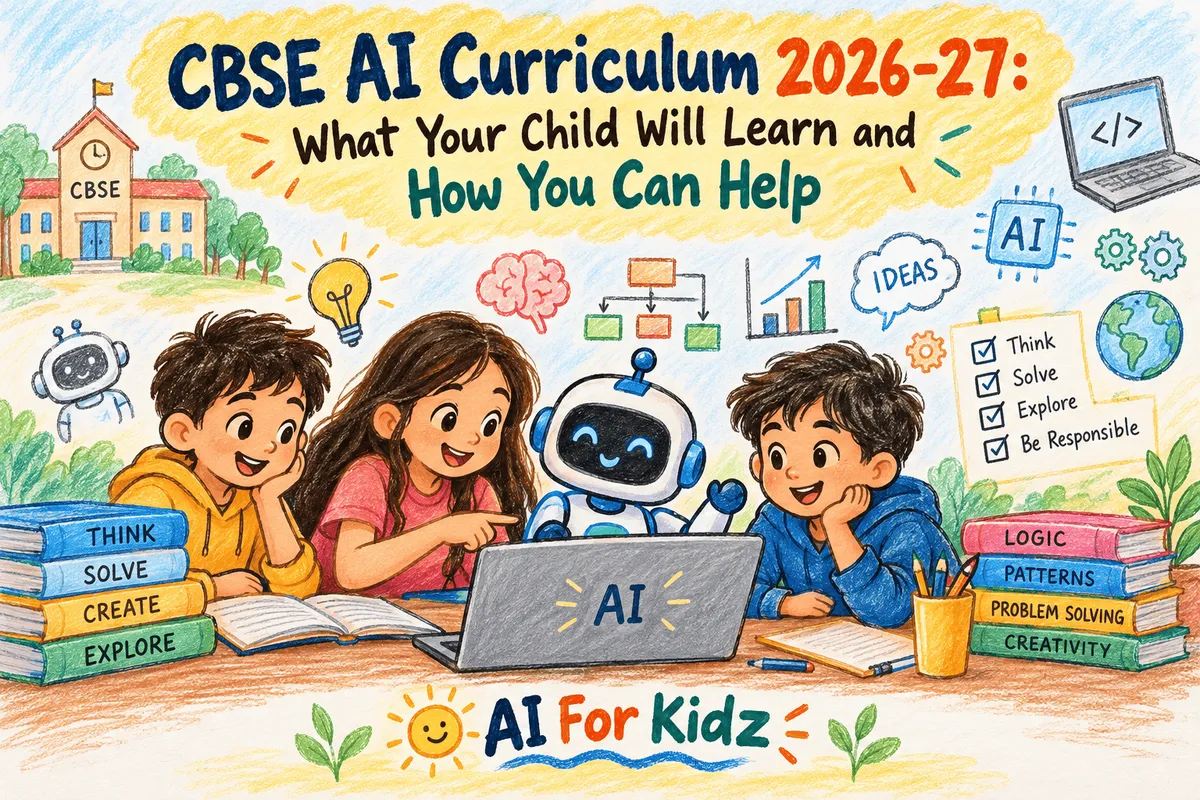

Artificial Intelligence is already influencing how students learn, search for information, create content, and interact with technology. But understanding AI requires more than knowing how to use a chatbot. Students also need to understand how AI works, why it makes mistakes, and how to use it responsibly.
On 23 October 2026, the National Council of Educational Research and Training (NCERT) announced an introductory module on Computational Thinking (CT) and Artificial Intelligence (AI) for Classes 9–12. Designed for students without prior knowledge of AI, the module focuses on practical activities, critical thinking, problem-solving, and responsible technology use.
The announcement raises several important questions for students and parents. What will students learn? Does the module require coding? Will it be assessed? And how can families prepare?
Here is a detailed look at the NCERT AI module for the 2026–27 academic session, including its five units, learning approach, and what parents and teachers should know.
Official resources: NCERT official website | CBSE Academic Circulars
NCERT AI Module 2026–27: Key Highlights
Here are the main details of the new NCERT Computational Thinking and AI module.
| Detail | Information |
|---|---|
| Developed by | NCERT, in consultation with IIT Madras and IIT Jodhpur |
| Target classes | Classes 9–12 |
| Academic session | 2026–27 |
| Duration | 20 hours |
| Structure | Five learning units |
| Prior AI knowledge | Not required |
| Learning approach | Experiential and activity-based |
| Digital devices | Activities can be conducted with or without devices |
| Main focus | Computational thinking, AI literacy, critical thinking, privacy, and responsible AI |
The module aligns with the vision of the National Education Policy (NEP) 2020. Rather than concentrating only on technical definitions, it encourages students to explore AI through discussions, practical exercises, experimentation, and reflection.
Is This a CBSE Module or an NCERT Module?
The module has been developed by NCERT, not directly by CBSE. However, the two organisations have closely related roles in school education.
NCERT develops educational resources, textbooks, and curriculum-related materials. CBSE is a school education board that issues academic guidelines and conducts board examinations for its affiliated schools.
The distinction matters because the release of an NCERT learning resource does not, by itself, establish every detail of how an individual school will implement it.
CBSE's Circular Acad-18/2026, dated 9 April 2026, states that NCERT would provide Computational Thinking and AI modules for Classes 9–12 during the 2026–27 session, to be used as modules for internal assessment.
The same circular also discusses changes to existing AI courses for Class IX and the continuation of the previous scheme for Class X during 2026–27.
What should students do? Check the latest notices issued by their school and consult the official CBSE academic circulars for applicable instructions.
What Will Students Learn in the NCERT AI Module?
The introductory module is organised into five units. Together, they help students recognise AI in everyday life, understand how machines learn, evaluate AI-generated information, protect personal data, and use AI tools responsibly.
Unit 1: AI Is Already in Your Life
Students begin by exploring how AI appears in everyday situations.
Think about a smartphone keyboard that predicts the next word, a music application that recommends songs, or a system that recognises patterns in images. These examples show how technology can use patterns to make predictions or provide recommendations.
Students also explore the limitations of AI. A system may recognise patterns without understanding a situation in the same way a human does.
What students learn:
- Recognising AI in everyday applications.
- Understanding patterns and predictions.
- Exploring the difference between human judgement and machine outputs.
- Identifying situations in which AI may be useful or unreliable.
Simple example: A music app recommends songs based on listening patterns. Its recommendations may be useful, but they will not always match a student's current mood or preferences.
Unit 2: How Machines Learn from Examples
How does an AI system recognise an object or identify a pattern?
This unit introduces students to the idea that machine learning systems can learn patterns from examples. Students explore how training data influences the results produced by an AI model.
A practical activity might involve training an image classifier to recognise familiar objects and then testing it with examples it has not seen before.
This helps students understand that an AI model does not automatically become accurate simply because it has been trained.
What students learn:
- How AI systems use examples and data.
- Why the quality and variety of training data matter.
- How to test a model's predictions.
- Why an AI system may fail when it encounters unfamiliar examples.
Simple example: Suppose a model is trained using pictures of red apples taken against white backgrounds. It might struggle to recognise a green apple or an apple photographed in a different setting.
The lesson is simple: the examples used to train an AI system can influence what it learns and how well it performs.
Unit 3: When AI Gets It Wrong
AI-generated answers can sound confident even when they contain errors. Images, audio, and videos can also be manipulated or generated to mislead people.
This unit introduces students to misinformation, deepfakes, and incorrect AI-generated responses. It encourages them to verify information instead of accepting every digital output as true.
Students should develop the habit of asking questions such as:
- Who created this information?
- What evidence supports the claim?
- Can I verify it through reliable, independent sources?
- Could this image, video, or audio clip have been manipulated?
- Am I certain enough to share it?
Why this unit matters: Students regularly encounter information through social media, search engines, messaging applications, and AI tools. Learning to question and verify that information is an important digital skill.
For example, an AI chatbot might provide an incorrect historical date with a convincing explanation. Checking the answer against a textbook or a reliable reference helps students recognise the difference between a plausible response and a verified fact.
The goal is not to distrust every AI-generated answer. It is to understand that AI outputs require appropriate checking.
Unit 4: Your Data and Your Privacy
AI tools often process information provided by users. Understanding what information should remain private is therefore essential.
This unit addresses personal data, consent, fairness, and digital safety. It also introduces students to privacy considerations, including India's Digital Personal Data Protection Act, 2023.
Students can learn to review the privacy policies of applications they use and think carefully about what information they share online.
Important safety rules for students:
- Never share passwords or one-time passwords (OTPs) with an AI tool.
- Avoid entering Aadhaar or PAN details and other sensitive identification information.
- Do not upload private documents or personal photographs without appropriate authorisation and safeguards.
- Respect the privacy of classmates, friends, and family members.
- Check what information an application collects and how it may be used.
Simple example: If a student wants an AI tool to explain a school assignment, they can share the question without uploading their school identity card or a document containing personal details.
Learning to use AI responsibly includes knowing when not to share information.
Unit 5: Using AI Tools Well
The final unit focuses on using AI tools effectively while keeping human thinking at the centre of the learning process.
Students explore how to write clearer prompts, assess the answers generated by AI, and identify mistakes that need correction.
They also learn why AI should support learning rather than replace their own effort.
What students learn:
- Writing clear and relevant prompts.
- Evaluating AI-generated answers.
- Identifying errors and misleading information.
- Improving their work with appropriate AI assistance.
- Taking responsibility for their final decisions and submissions.
Simple example: A student can ask an AI tool to explain a difficult mathematics concept step by step. The student should then solve practice questions independently and check whether the explanation is correct.
The objective is to use AI as a learning assistant, not as a substitute for understanding.
What Is the Curious Notebook?
The module also introduces a running record of students' observations, reasoning, and reflections called the Curious Notebook.
Instead of recording only definitions, students can document what they notice during activities, what they learn from experiments, where an AI system makes mistakes, and how their understanding changes.
For example, after testing an image classifier, a student might record which objects it recognised correctly, which objects it misclassified, and what could explain those errors.
This approach encourages students to reflect on their learning rather than simply memorise information.
Can Students Learn AI Without a Computer?
Yes. According to NCERT's announcement, the module's activities can be conducted with or without digital devices.
Depending on classroom resources, teachers can use different approaches:
1. Individual or pair-based activities: Students work with digital devices to explore AI concepts and test models.
2. Teacher-led demonstrations: A teacher demonstrates an activity on a shared screen while students observe, discuss, and analyse the results.
3. Unplugged activities: Students use paper-based exercises, discussions, and classroom activities to explore patterns, logical reasoning, and problem-solving.
This flexibility allows teachers to introduce computational thinking concepts even when every student does not have access to a computer or a reliable internet connection.
It also reinforces an important idea: students can develop computational thinking skills through reasoning and structured problem-solving, not only through coding.
Is the NCERT AI Module Compulsory for Classes 9–12?
This is one of the most important questions for students and parents.
CBSE Circular Acad-18/2026 states that NCERT would provide CT and AI modules for Classes 9–12 for the 2026–27 session, to be transacted as modules for internal assessment.
The circular also specifies that other AI courses running through the 2025–26 session are being discontinued for Class IX from 2026–27, while Class X students in 2026–27 continue under the previous scheme.
However, students should distinguish between the published policy and the precise arrangements their schools will follow.
For the latest applicable requirements, consult:
- Your school's official academic notices.
- CBSE's official academic circulars.
- NCERT's official website.
Will the NCERT AI Module Be Included in Board Exams?
The CBSE circular describes the Classes 9–12 modules as being intended for internal assessment. This is not the same as announcing a separate board-examination paper.
Students should not assume that the module creates a new board exam. For the exact assessment format, marking arrangements, and school-level implementation, follow the latest official instructions.
Does the Module Require Coding?
No prior knowledge of AI is required. The module is introductory and activity-based, with activities that can be conducted with or without digital devices.
Students can begin by exploring patterns, solving problems, analysing examples, and evaluating AI outputs. They do not need to start by learning advanced programming or mathematics.
How Can Parents Help Their Children Learn AI?
Parents do not need a technical background to support their child's AI education. Simple activities and everyday conversations can help students build good habits.
1. Identify AI in Everyday Life
Spend a week noticing where AI appears in everyday applications. Discuss recommendations, voice typing, image recognition, and other familiar examples.
Ask your child what the system might be using to make a prediction or recommendation.
2. Check an AI Answer Together
Ask an AI tool a question about a topic your child already understands. Compare its answer with a textbook or another reliable source.
Discuss any mistakes and why the answer might have seemed convincing at first.
3. Set Clear Rules for Personal Data
Explain why passwords, OTPs, identification details, and private documents should not be shared with AI tools.
Encourage your child to ask for help before uploading personal information or photographs to unfamiliar applications.
4. Pause Before Sharing Online Content
If your child encounters a surprising video, screenshot, or news claim, encourage them to verify it before forwarding it.
Discuss the source, look for independent confirmation, and consider whether the content could be manipulated.
5. Encourage Independent Thinking
If your child uses AI for homework, ask them to explain the answer in their own words. Encourage them to solve problems, question suggestions, and check facts rather than copying an AI-generated response.
These habits support both academic learning and responsible technology use.
Practical AI Activities for Students and Teachers
The module's activity-based approach also creates opportunities for simple classroom exercises.
| Activity | What students practise |
|---|---|
| Spot AI around you | Identifying everyday applications of AI |
| Train an image classifier | Understanding examples, data, and model predictions |
| Verify an AI-generated answer | Checking sources and identifying errors |
| Review an application's privacy policy | Understanding data collection and consent |
| Improve an AI prompt | Communicating clearly and evaluating outputs |
Teachers can adapt activities to the time, devices, and learning resources available in their classrooms. Where an online tool is used, they should select age-appropriate options and follow appropriate privacy safeguards.
Questions Parents Should Ask Their Child's School
If your child is in Classes 9–12, these questions can help you understand how the module will be introduced.
- Will the school implement the NCERT CT and AI module during the 2026–27 session?
- Which classes will participate, and when will the activities begin?
- How will the module be incorporated into internal assessment?
- Will students need access to individual devices or specific applications?
- What measures will the school take to protect students' personal data?
- How will students' activities and learning progress be documented?
The answers will help parents understand the school's approach without relying on unverified social media claims.
Frequently Asked Questions (FAQs)
1. What is the NCERT AI module for Classes 9–12?
It is an introductory module on Computational Thinking and Artificial Intelligence developed by NCERT for students in Classes 9–12. Announced on 23 October 2026, it uses activity-based learning to develop problem-solving skills, AI awareness, and responsible technology use.
2. How many hours is the NCERT AI module?
The module is reported as a 20-hour learning programme organised into five units.
3. What are the five units of the NCERT AI module?
The five units cover AI in everyday life, how machines learn from examples, when AI gets things wrong, data and privacy, and using AI tools well.
4. Is the NCERT AI module for CBSE students?
The module was developed by NCERT. CBSE Circular Acad-18/2026 states that NCERT would provide CT and AI modules for Classes 9–12 for the 2026–27 session for internal assessment. Students should check their schools' latest instructions for implementation details.
5. Is the NCERT AI module compulsory for Class 9?
CBSE's 2026–27 circular addresses the use of CT and AI modules for internal assessment and changes to previous AI courses for Class IX. Students should consult the relevant official circulars and their schools for the applicable requirements.
6. Will the NCERT AI module be part of board exams?
The circular describes the modules as intended for internal assessment. It does not announce a separate board-examination paper for this module. Follow official instructions for the final assessment arrangements.
7. Does the NCERT AI module require coding?
No prior knowledge of AI is required. The module uses practical activities, discussions, and experimentation, including activities that can be conducted without digital devices.
8. Where can I download the NCERT AI module PDF?
Visit NCERT's official website and look for An Introductory Module on AI & CT (Secondary Stage Grade 9 to 12).
Final Thoughts: Why AI Literacy Matters for Students
The NCERT AI module for Classes 9–12 is about more than learning to use new technology. It introduces students to computational thinking, the limitations of AI, the importance of reliable information, and the need to protect personal data.
These skills can help students approach technology with curiosity while maintaining the ability to question, evaluate, and make independent decisions.
For parents, the best starting point is to encourage children to explore AI thoughtfully, verify information, and protect their privacy. For teachers, it is an opportunity to make learning practical, engaging, and relevant to students' everyday experiences.
Want to help your child build future-ready skills? Explore more AI learning resources, practical activities, and beginner-friendly guides on AIForKidz.in.
Editorial note: Academic policies and school-level implementation can change. Always refer to the latest official NCERT and CBSE publications for the most current requirements.